Saltar al contenido
ORIGINS & VISION

From cooling sensation to verifiable microclimate science.

Arc-Chill did not begin as a single cooling claim. It began as a way to connect materials, fiber structure, human microclimate, and authorization verification so comfort regulation can be clearly defined, consistently applied, and repeatedly checked.

The evolution of cooling comfort

Cooling comfort began as a description of the temperature difference felt when textiles touch the skin.

Traditional cool-touch claims were often short-lived and inconsistent, without a shared definition, test method, or reproducible data.

As functional fibers and textile-structure processes developed, cooling comfort entered the textile field as a way to describe the temperature difference perceived at first contact.

For a long period, however, many cooling-fabric claims stayed close to sensory promotion and short-lived experience. Instant cool touch created by simple coating or additives was often generalized into a long-term effect, without a unified technical definition, testing method, or reproducible data behind it.

For people who are sensitive to body sensation, fragile sleep, or environmental changes, this kind of cooling may only work within a short time window. It is difficult for it to maintain a stable and predictable comfort state across an entire sleep cycle or extended wear duration.

01Conventional cool touch
  1. Initial heat
  2. Contact cooling
  3. Heat returns
  4. Heat accumulates
  5. Heat builds up
02Arc-Chill microclimate control
  1. Initial heat
  2. Contact cooling
  3. Heat is dispersed
  4. Microclimate stabilizes
  5. Cooling remains stable

Reframing the problem from materials

Arc-Chill began by studying inorganic mineral components, their microstructure, and their thermal behavior at fine scale.

We explore fiber cross-sections and guided flow structures to understand heat and moisture transfer at both fiber and textile structure levels.

The starting point of Arc-Chill research was to deconstruct the cooling problem from the material side. The work focuses on specific inorganic mineral components, including jade-like mineral materials, and studies their microstructure and thermal-physical properties.

At fine scale, the research examines heat conduction, heat storage behavior, and the influence created when mineral components are combined with a fiber matrix. The goal is to understand how these structures affect overall textile heat transfer and the microenvironment near the human body surface.

Combined with profiled fiber cross-sections and guided flow structures, Arc-Chill studies the transfer path of heat and humidity between skin and the surrounding small environment at both fiber and textile-structure levels, instead of relying only on a surface coating for a short-term feeling.

  1. Mineral-integrated fibers within a cooling textileMineral-integrated fibers
  2. Engineered yarn structures supporting heat and moisture movementEngineered yarn structure
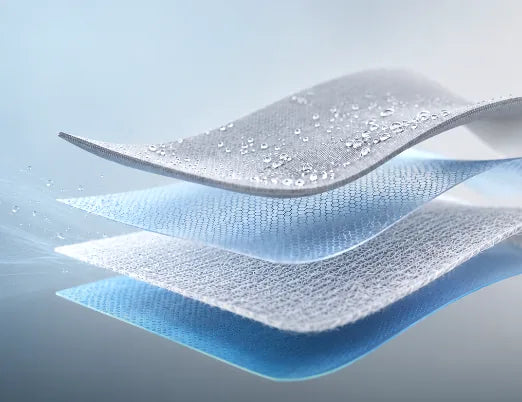
  3. Layered surface configuration for cooling textilesSurface-layer configuration

The microclimate between body and textile

Arc-Chill focuses on the local microclimate between the human body and textile systems, where air, heat, and humidity interact.

The goal is to maintain a stable thermal-moisture balance and reduce discomfort across different conditions and durations.

Arc-Chill Lab studies the local microenvironment between the body and textile. In summer or warm environments, body-state changes such as metabolism, circulation, and hormonal variation interact with air-conditioning conditions and the structure of clothing or bedding.

The research question is how to maintain a relatively stable heat-humidity balance under different contact methods and use durations, reducing discomfort such as overheating, stuffiness, perspiration, temperature-gap discomfort, and long-sleep heat buildup.

In this process, cooling comfort is not treated as a single sensation. It is broken down into a set of material and body-sensation parameters that can be measured, modeled, and verified.

Heat and moisture movement between skin and textile structure

Material technology and standardized authorization

Arc-Chill integrates material science, indicator systems, test methods, and authorization configurations.

All claims connect to a public indicator system, testing methods, and authorization configurations for clear verification.

Based on this technical path, Arc-Chill is built as a combination of material technology and standardized authorization configuration. Cooling performance, breathability, skin comfort, moisture management, and other dimensions can be combined into a framework for research and product development.

Through authorization configurations, testing standards, and public query mechanisms, the framework extends beyond the laboratory into real brand and product systems. A product claim that uses Arc-Chill technology can therefore correspond to a clear indicator system and verification path.

For brand and R&D partners in bedding, home textiles, apparel, baby care, healthcare, and related fields, Arc-Chill is not a single material formula. It is a technical and compliance framework covering indicator definition, testing method, configuration standard, authorization, and re-check mechanisms.

  1. 01Material sampleMaterial composition and intended use are defined.
  2. 02Laboratory validationSelected performance criteria are tested and documented.
  3. 03ACT configurationThe approved configuration and claim scope are recorded.
  4. 04Authorization releaseAuthorized brand use enters the public verification system.

From standards to a collaborative ecosystem

Arc-Chill builds and improves the standards system through innovation, testing, and continuous improvement.

We work with fiber, textile, testing, and brand partners to make cooling and comfort-regulation technologies more reliable and widely applied.

In a market where cooling claims can be complex and inconsistent, Arc-Chill keeps its focus on material innovation, testing methods, and continuous improvement of the standards system.

The system is designed to keep expanding quantifiable indicators, iterating heat-humidity regulation solutions, and strengthening authorization and re-check mechanisms, so high-standard cooling and comfort-regulation technologies can be referenced more clearly in sleep and broader close-to-skin scenarios.

When a product claims to use Arc-Chill technology, that claim should map to a public indicator system, testing methods, and authorization configuration. This creates a more stable, transparent, and verifiable connection between material performance and human experience.

Arc-Chill will continue to work with fiber, textile, testing, and brand partners to define, apply, and evolve cooling and comfort-regulation technologies across more scenarios.

Material & textile partnersFiber, yarn, fabric and product engineering
Testing & standards partnersMethods, evidence and periodic verification
Authorized brandsApproved products, claims and consumer communication
Arc-ChillStandards & feedback loopShared rules, configuration records and continuous improvement